
BYDealers
Dealer's expertise delivered to auctions.
James Edward Hervey (J. E. H.) MacDonald
1873-1932
James Edward Hervey (J. E. H.) MacDonald brought to Canadian landscape painting a distinctive synthesis of decorative structure, expressive colour and close observation of nature. A founding member of the Group of Seven, he was instrumental in shaping the visual language that emerged around the group during the early decades of the twentieth century.
Trained in commercial art and design, MacDonald approached landscape with a pronounced sensitivity to pattern, rhythm and the organization of the pictorial surface. His paintings of Algoma, Georgian Bay and the Canadian Rockies move beyond topographical description, translating the natural world into dense arrangements of colour and form. Particularly in his mature work, trees, mountains, clouds and changing atmospheric conditions become vehicles for an increasingly expressive and highly orchestrated conception of landscape.
MacDonald’s practice reflects the broader ambitions of early Canadian modernism: to reconcile direct experience of the land with a new and distinctly contemporary pictorial language. His influence extended beyond his own painting through his work as a designer, teacher and central figure in the intellectual and artistic life of the Group of Seven.
Past artworks by James Edward Hervey (J. E. H.) MacDonald
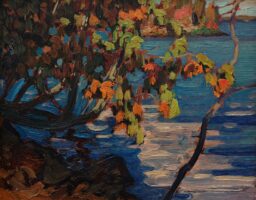
Cedars, Little Turtle Lake
James Edward Hervey (J. E. H.) MacDonald
BYDealers- Richard Kastner Estate Collection - 2nd Session - May 6 to May 26, 2026, 8PM (EDT)
Sold for $120,000 CAD
Footer

