


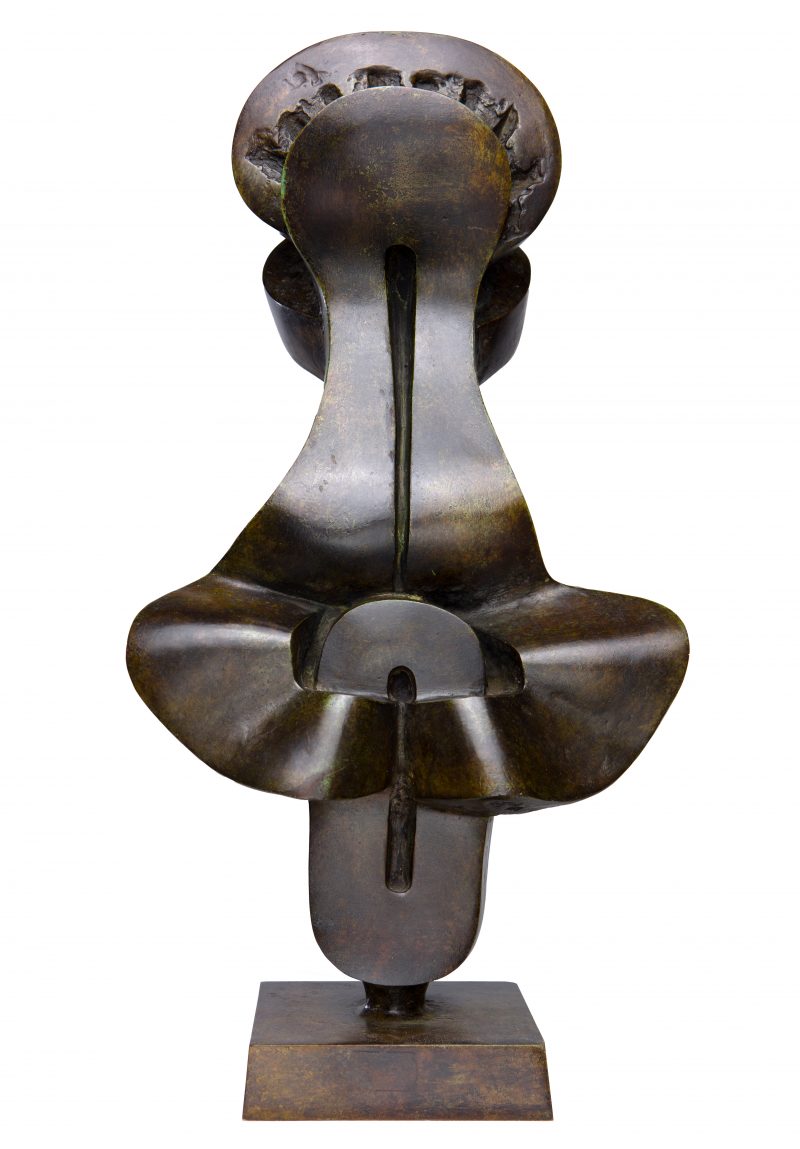


The mother figure is a recurring motif in the sculptural oeuvre of Sorel Etrog, and it is the underlying inspiration for Madonna Bust. Created between 1963 and 1966, this expressive biomorphic sculpture evokes the head and shoulders of an abstract female figure. The face, arms, and hands of the Madonna are delineated with a smooth, undulating ribbon of bronze; above her head, a semi-circle punctuated with a row of small linear indentations evokes a diadem. Displaying a near-total bilateral symmetry, the sculpture is imbued with a quiet sense of serenity, all the while maintaining the organic vitality characteristic of Etrog’s sculptural work.
Although some critics have noted the influence of Cubist sculptor Jacques Lipchitz on Etrog’s sculptural aesthetic during this period, particularly in the rippling ribbon-like forms seen in sculptures such as Madonna Bust, Flight, and Sunbird II, contemporary drawings show that Etrog was influenced primarily by Etruscan antiquities. He had moved from Tel Aviv to New York in 1959 to attend the Brooklyn Museum Art School. The museum’s collection of Etruscan antiquities enthralled the young student, and in 1963 he travelled to Florence to further explore ancient Etruscan sculpture. Madonna Bust, which Etrog began shortly after his return from Italy, bears a striking resemblance to the female terracotta busts of the ancient culture, particularly in the presence of the diadem and the gently forward-tilting angle of the head.

