


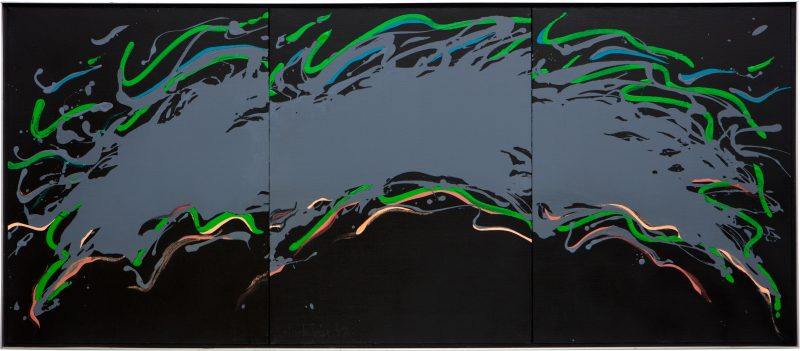

After the tragic death of his daughter, Nathalie, Jacques Hurtubise took refuge in his work, embarking on a period of frenzied production that lasted from 1980 to 1993. During that time, the artist created a series of symmetrical paintings reminiscent of Rorschach inkblots, which gave free reign to the imagination and interpretation of the viewer. Already distinct from his peers stylistically, Hurtubise intensified his pictorial approach, applying the formal principles of the Plasticiens and the Automatists via a controlled gestural language. Here, he drew upon the techniques of previous decades, and on his mastery of printmaking processes, such as monotype, decal, and screenprinting. Hurtubise built up his works in successive layers, applying medium to half the canvas and folding it against its opposite, using a folding armature of stretched canvases mounted in pairs. Mechanically, Hurtubise repeated this gesture dozens, even hundreds of times before achieving the desired effect. “[T]he cultural and stylistic otherness to which the motifs allude—a bestial, oriental, heterogeneous morphology—test the visual and intellectual concept. These constructions are dramatic, astonishing and, ultimately, oustandingly unique,” writes Jocelyne Connolly (“Turbulence and organization. A model of singularity,” in Hurtubise sans réserve, Fondation J. Armand Bombardier, 2001).

BYDealers
Dealer's expertise delivered to auctions.
Browse Auction lots
-
Online Auction (do not delete),
Lot 0 -

Léon Bellefleur
Sans titre nº 1, Paris, 1955
Sold for $15600 CADLot 1 -

Léon Bellefleur
Sausset-les-pins, 1959
Sold for $20400 CADLot 2 -

Marc-Aurèle Fortin
Coin du port de Montréal, circa 1925
Sold for $13200 CADLot 3 -

Jean Paul Lemieux
Untitled, 1980
Sold for $33000 CADLot 4 -

Jean Paul Lemieux
Nora et Olivia Atkins, 1982
Lot 5 -

Miyuki Tanobe
On pratique à n’importe quelle saison, 2007
Sold for $16800 CADLot 6 -

Jean-Philippe Dallaire
Qui est coupable ?, 1948
Lot 7 -

Harold Barling Town
Through Utrillo’s Garden, 1954
Sold for $9000 CADLot 8 -

Ulysse Comtois
Materiel, 1952
Sold for $6600 CADLot 9 -

Kazuo Nakamura
Untitled (Block Structure), 1956
Lot 10 -
Louis Belzile
Untitled, 1957
Sold for $16800 CADLot 11 -

Victor Vasarely
Kezdi, 1966
Lot 12 -

Karel Appel
Animals Coming from the Sun, 1957
Sold for $78000 CADLot 13 -

Lise Gervais
Untitled, 1961
Lot 14 -

Jack Hamilton Bush
Summer Gone, 1976
Lot 15 -

Sorel Etrog
Madonna Bust, 1963-1966
Lot 16 -
Jean-Paul Armand Mousseau
Untitled (lampe), circa 1960
Sold for $7800 CADLot 17 -
Jean LeFebure
Untitled, 1960
Lot 18 -
Fernand Toupin
Surgissement, 1959
Sold for $14400 CADLot 19 -

Marian Dale Scott
Untitled, 1967
Sold for $7800 CADLot 20 -

Jean Paul Riopelle
Décembre Orléans, 1959
Sold for $870000 CADLot 22 -
Marcelle Ferron
Untitled, 1961
Lot 23 -

Claude Tousignant
Double 36, 1972
Sold for $90000 CADLot 24 -

Serge Lemoyne
Les Étoiles (rouge), 1979
Lot 25 -

Jean Albert McEwen
Les contes arabes nº 2, 1964
Sold for $45000 CADLot 26 -

Fernand Leduc
Untitled, 1965
Lot 27 -

Jacques Hurtubise
Ephramille, 1966
Sold for $78000 CADLot 28 -

Edmund Alleyn
Untitled, 1966
Lot 29 -
Rita Letendre
Reflections, 1970
Sold for $27000 CADLot 30 -

William Perehudoff
AC-81-3, 1981
Lot 31 -
Harold Barling Town
Optical, 1960
Sold for $21600 CADLot 32 -

Yves Gaucher
J.G./Ps, 1989
Sold for $51000 CADLot 33 -
Fernand Toupin
Îles sous le vent, 1962
Sold for $8400 CADLot 34 -

Jean-Paul Jérôme
Untitled, 1969
Sold for $5100 CADLot 35 -
Marcella Maltais
Mer glauque, 1960
Sold for $7800 CADLot 36 -

Marcelle Ferron
Composition, 1960
Sold for $16800 CADLot 37 -
Jean Albert McEwen
Élégie criblée de bleu nº 7, 1986
Sold for $42000 CADLot 38 -

Raymond John Mead
Untitled, 1987
Lot 39 -

Serge Lemoyne
Untitled (série Bleu, Blanc, Rouge), 1975
Sold for $78000 CADLot 40 -
Françoise Sullivan
Red Glow, 2003
Sold for $14400 CADLot 41 -

Murray Favro
Guitar, 1993
Lot 42 -
Murray Favro
An Old Painting, circa 1962
Sold for $15600 CADLot 43 -
Jean-Paul Jérôme
L’astrée mythique, 1992
Sold for $20400 CADLot 44 -

Jacques Hurtubise
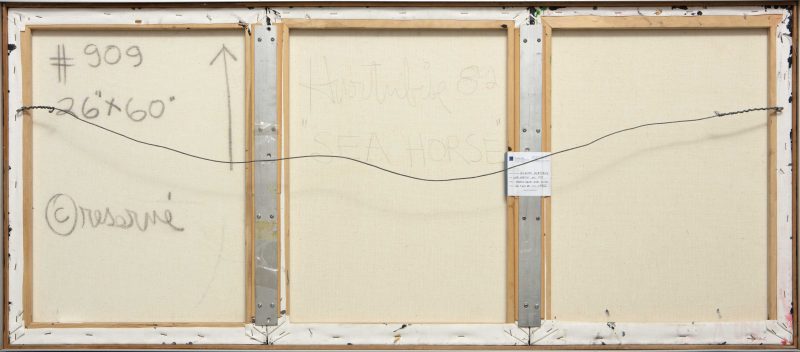
Sea Horse nº 909, 1982
Lot 45 -

Serge Lemoyne
Série Rideau (doré, noir, bleu, blanc et rouge), 1984
Sold for $19200 CADLot 46 -

Fernand Toupin
Boléro, 1985
Sold for $13200 CADLot 47 -

Marcelle Ferron
Untitled, 1988
Sold for $18000 CADLot 48 -

Francine Simonin
Free Jazz Yellow, 2006
Sold for $15000 CADLot 49 -

Norman Bluhm
Sleeping Goddess, 1983
Sold for $19200 CADLot 50 -

Marc Garneau
Noroît, 1990
Sold for $18600 CADLot 51 -

Betty Roodish Goodwin
Figure with Megaphone, 1988
Sold for $54000 CADLot 52 -
Iain Baxter&
Line, 1968
Lot 53 -

Barry Allikas
C.031/Self-Assembly, 1999
Sold for $9600 CADLot 54 -

Cal Lane
Covet Rug Drum, 2009
Sold for $27000 CADLot 55 -
Louis Boudreault
Portrait of Picasso, 2007
Sold for $18000 CADLot 56 -

Yehouda Chaki
Spring Landscape,
Sold for $19200 CADLot 57 -

Tony Scherman
Welcome to Colombia, 1986
Sold for $12,000 CADLot 58 -

Bonnie Baxter
Monarch Beach I-II-III-IV, 2008
Lot 59 -
Marc Séguin
Untitled (Géométrie), 1999
Sold for $24000 CADLot 60


Footer

