

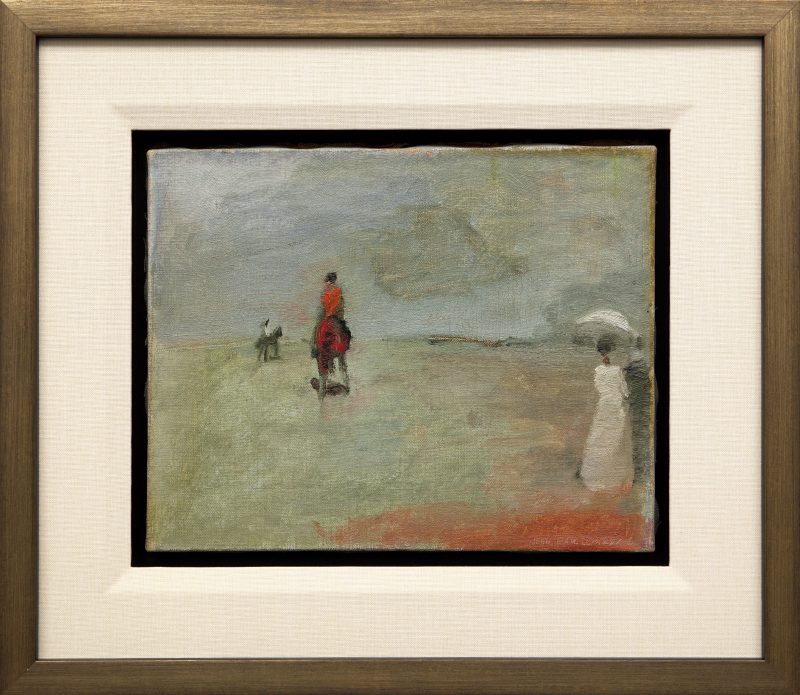
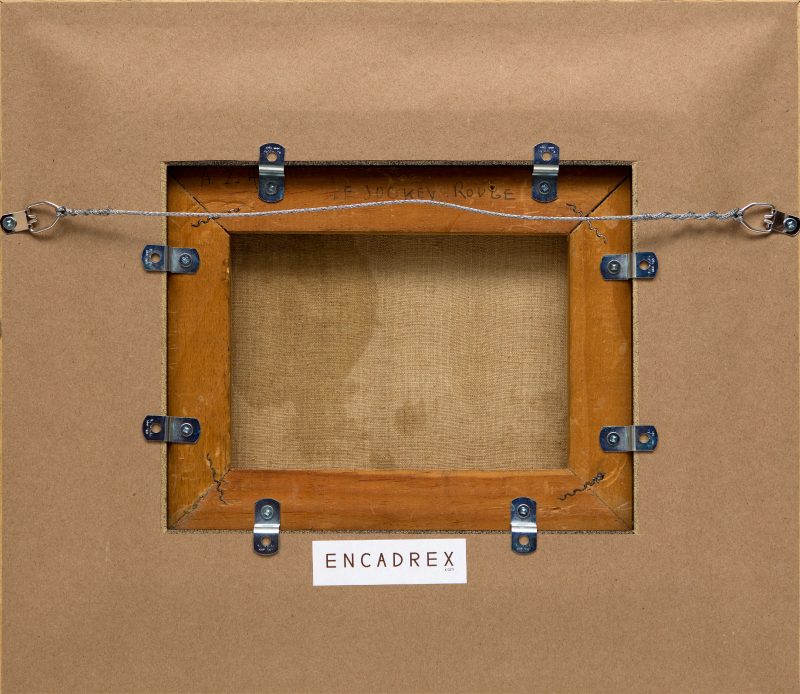
Le jockey rouge (1961) features many of the motifs that brought Jean Paul Lemieux into prominence: infinite space, sloping horizons, truncated figures, distant silhouettes on the edge of the frame, and a prominent figure on horseback. The jockey, dressed in an orange jersey, his back to the viewer, sits tall astride his gleaming mount. He seems to be heading toward a woman, also riding a horse, dressed in white, with long flowing hair, off in the distance. Although the equestrian motif is present throughout several key periods of Lemieux’s career (Le cavalier, 1964; Cavalier dans la neige, 1967; Cavalier au bord d’un lac, 1970; L’été, 1976), here it appears not once, but twice. Le jockey rouge—like many of Lemieux’s emblematic paintings—has the festive ambience of strolls in the countryside (1910 Remembered, 1962; L’été de 1914, 1965), sunbathing in a white dress (La plage américaine, 1973), and large outdoor summer gatherings (Les noces de juin, 1972).

BYDealers
Dealer's expertise delivered to auctions.
Browse Auction lots
-
Online Auction (do not delete),
Lot 0 -

Edmund Alleyn
Abstraction, 1962
Sold for $10800 CADLot 1 -

Edmund Alleyn
Chair de poule, 1964
Sold for $18000 CADLot 2 -

Marcel Christian Barbeau
Rétina 319-K, 1966
Sold for $40800 CADLot 3 -

Marcel Christian Barbeau
Sauvage-furie ou Automne-délire, 1947
Sold for $44400 CADLot 4 -

Léon Bellefleur
Mont-Saint-Michel, 1975
Sold for $16800 CADLot 5 -

Léon Bellefleur
Lueurs d’hiver, 1970
Sold for $9000 CADLot 6 -

Dominic Besner
L’aisance de la grande strassedam notoire, 2009
Sold for $24000 CADLot 7 -

Paul-Émile Borduas
Modulation aux points noirs, 1955
Sold for $444000 CADLot 8 -

Ulysse Comtois
Evening, 1991
Sold for $12000 CADLot 9 -

Ulysse Comtois
Lumière d’été IV, 1976
Sold for $7800 CADLot 10 -

Jean-Philippe Dallaire
Untitled, 1951
Sold for $9000 CADLot 12 -

Jean-Philippe Dallaire
Untitled, 1958
Sold for $19200 CADLot 13 -

Kim Dorland
Her #3, 2007
Sold for $10800 CADLot 14 -

Jacques De Tonnancour
Près du lac, 1956
Sold for $11400 CADLot 15 -

Ivan Kenneth Eyre
Nest Rest, 1970
Sold for $38400 CADLot 16 -

Marcelle Ferron
Untitled, 1959
Sold for $12000 CADLot 17 -

Marcelle Ferron
Untitled, 1963
Sold for $24000 CADLot 18 -

Marcelle Ferron
Untitled, 1988
Sold for $13200 CADLot 19 -

Marc-Aurèle Fortin
Paysage d’automne à Piedmont, 1930
Sold for $8400 CADLot 20 -

Marc Garneau
Rouge ou blanc, 2006
Sold for $10800 CADLot 22 -

Yves Gaucher
Signals—Eight Inch Progressions, 1966
Sold for $42000 CADLot 23 -

Yves Gaucher
DR + P’s, 1989
Sold for $11400 CADLot 24 -

Pierre Gauvreau
Crépusculaire, 1962
Sold for $24000 CADLot 25 -

Pierre Gauvreau
Les cerises de l’archiduchesse, 1978
Sold for $16800 CADLot 26 -

Lise Gervais
La chasse à l’orignal, 1988
Sold for $6600 CADLot 27 -

Jacques Huet
Untitled, 1987-2007
Sold for $9600 CADLot 28 -

Jacques Hurtubise
Gri-Griffeux, 1987
Sold for $16800 CADLot 29 -

Jacques HurtubiseJacques Hurtubise
Danielle, 1966
Sold for $81000 CADLot 30 -

Geoffrey JamesGeoffrey James
The East Meadow, Central Park, 1991
Sold for $7800 CADLot 31 -

Jean-Paul Jérôme
Les clochettes-quatre, 1994
Sold for $12000 CADLot 32 -

Jean-Paul Jérôme
La lumière passe de deux, 1993
Sold for $14400 CADLot 33 -

Jean-Paul Jérôme
Kaléidoscope-deux, 1999
Sold for $13200 CADLot 34 -

Denis Juneau
Jaune sur bleu, 1966
Sold for $38400 CADLot 35 -

Jean LeFebure
Untitled, 1962
Sold for $6600 CADLot 36 -

Jean Paul Lemieux
Nu sur fond bleu, 1963
Sold for $300000 CADLot 37 -

Jean Paul Lemieux
Retour au village, circa 1975
Sold for $198000 CADLot 38 -

Jean Paul Lemieux
Le jockey rouge, 1961
Sold for $46800 CADLot 39 -
Serge Lemonde
Moteur, 2017
Sold for $6600 CADLot 40 -

Serge Lemoyne
Deux cibles, 1983
Sold for $24000 CADLot 41 -

Serge Lemoyne
Untitled (série Bleu, blanc, rouge), 1976
Sold for $55200 CADLot 42 -

Rita Letendre
Meeting in Space, 1968
Sold for $31200 CADLot 43 -

Marcella Maltais
Untitled, 1958
Sold for $9600 CADLot 44 -

Marcella Maltais
Untitled, 1958
Sold for $8400 CADLot 45 -

André Marfaing
Untitled (Juillet 69-13), 1969
Sold for $60000 CADLot 46 -

Ronald Albert Martin
Bocour Red, 1973
Sold for $72000 CADLot 47 -

Jean Albert McEwen
Midi, temps jaune, 1960
Sold for $102000 CADLot 48 -

Raymond John MeadRaymond John Mead
Whirlygig, 1987
Sold for $25200 CADLot 49 -

Mario Merola
Vibrato bleu outremer, N.D.
Sold for $14400 CADLot 50 -

Alfred Pellan
Untitled, n.d.
Lot 51 -

Robert Wakeham PilotRobert Wakeham Pilot
Marché Bonsecours, Montréal, 1961
Sold for $7200 CADLot 52 -

René RichardRené Richard
Le vieux camp nº 1, Edmonton Ouest, 1968
Sold for $22800 CADLot 53 -

Jean Paul Riopelle
Untitled, 1962
Sold for $33600 CADLot 54 -

Jean Paul Riopelle
Untitled, 1958
Sold for $270000 CADLot 55 -

Louis Jaque
Intradorsale, 1970
Sold for $2040 CADLot 56 -

Jean Paul Riopelle
Relief, 1973 (cast: 1986)
Sold for $24000 CADLot 56 -

Jean Paul Riopelle
Untitled, 1958
Sold for $33600 CADLot 57 -

Jean Paul Riopelle
Nouvelles impressions nº 60, 1977
Sold for $49200 CADLot 58 -

Marc Séguin
Jeune femme au coeur (Branding Women Series), 2011
Sold for $30000 CADLot 59 -

Francine Simonin
Les jardins, 2003
Sold for $15600 CADLot 60 -

Miyuki Tanobe
La scène hivernale de la rue de l’Hôtel-de-Ville, 2013
Lot 61 -

Miyuki Tanobe
Le concours de la décoration de Noël, 2019
Sold for $20400 CADLot 62 -

Fernand Toupin
Hors-paysage, 1971
Sold for $20400 CADLot 63 -

Claude Tousignant
Écran chromatique, 1990
Sold for $9600 CADLot 64 -

Claude Tousignant
Double 30 (Azo-cobalt), 1975
Sold for $93000 CADLot 65 -

Yves Trudeau
Untitled, 1962
Sold for $24000 CADLot 66 -

David Urban
Untitled, 1998
Sold for $7800 CADLot 67 -

Armand Vaillancourt
Untitled, 1960
Sold for $33600 CADLot 68


Footer

