





Claude Tousignant was born in Montréal in 1932. Around 1955, he abandoned his gestural and tachiste style and began creating more geometric works. That same year, a handful of Montréal artists started to question the Automatist dogma by signing the Manifeste des Plasticiens. Included in this group were Fernand Toupin, Louis Belzile, Jean-Paul Jérôme, and Jauran, who were subsequently identified as Les Premiers Plasticiens (The First Plasticiens). Meanwhile, a second, more revolutionary group of artists, named Seconds Plasticiens (Second Plasticiens) formed around Guido Molinari and Claude Tousignant.
Today, Tousignant is primarily known for his round paintings. Starting in the mid-1960s, he devoted himself to the production of several series such as Les Gongs, Les Transformateurs chromatiques and Les Accélérateurs chromatiques, which feature concentric bands of sometimes saturated, sometimes fluorescent colours. In 1971, he decreased the number of bands and began painting them larger. In addition to these, Tousignant embarked on a series of diptychs, which he continued to produce until 1980. That same year, the Musée d’art contemporain de Montréal held an exhibition of his work devoted exclusively to his diptychs.
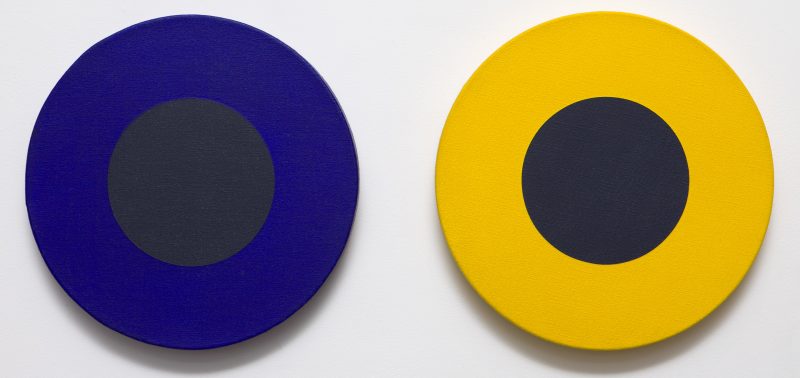
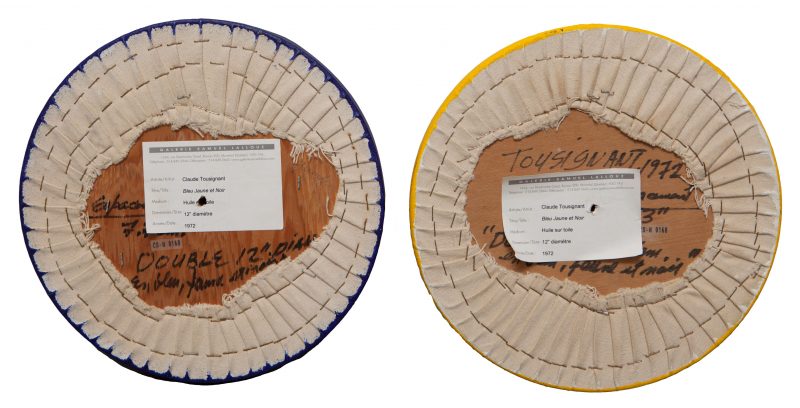
In Double 12 en bleu, jaune et noir, Tousignant brilliantly illustrates how the juxtaposition of black with two other colours—in this case blue and yellow—changes our perception of it. The exterior edges of both canvases are also painted, thus transforming the two pieces into a polychromatic sculptural work.

